Published by Saura ·
Potato vs sweet potato
Both roots are peeled and boiled for this comparison. See what a potato-for-sweet-potato swap changes in the fiber, carbs and calories on your plate.
Quick answer
Fiber per 100 g. Potato, peeled and boiled — 1 g. Sweet potato, peeled and boiled — 3 g.
Compare your portions
Enter the weight of each food in the preparation shown.
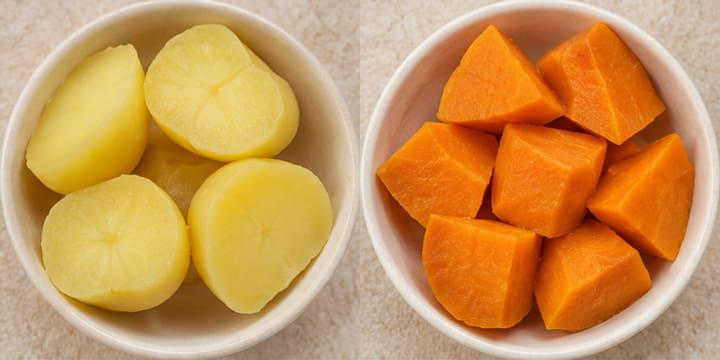
Compare the two bars within each row. Each nutrient has its own scale.
| Nutrient | Potato, peeled and boiled180 g | Sweet potato, peeled and boiled180 g |
|---|---|---|
| Energy | 136 kcal | 146 kcal |
| Protein | 3.4 g | 2.8 g |
| Available carbohydrate | 27.9 g | 30.3 g |
| Fat | 0.2 g | <0.1 g |
| Fiber | 1.8 g | 5.4 g |
Nutrition per 100 g
Values refer to 100 g of edible food in the stated preparation. Starting portions are examples. For USDA records, available carbohydrate is total carbohydrate minus fiber. Numbers are rounded after scaling.
Scroll sideways to see all columns. With a keyboard, focus the table and use the arrow keys.
| Nutrient | Potato, peeled and boiled | Sweet potato, peeled and boiled |
|---|---|---|
| Energy | 75 kcal | 81 kcal |
| Protein | 1.9 g | 1.6 g |
| Available carbohydrate | 15.5 g | 16.8 g |
| Fat | 0.1 g | <0.1 g |
| Fiber | 1 g | 3 g |
How to use the comparison
Use the drained weight before mashing. If one mash gets butter and the other gets milk, account for those separately. Baked wedges lose more water, and oil adds energy beyond the boiled values.
Nutrition values and photo results are estimates. Check ingredients and portions before saving a meal.
Keep exploring
- Potatoes nutrition: calories, protein and portion sizesPotatoes (peeled, boiled): about 75 kcal and 1.9 g protein per 100 g. See portion calculations, preparation notes and the exact Fineli source.
- Sweet potatoes nutrition: calories, protein and portion sizesSweet potatoes (raw, peeled): about 81 kcal and 1.6 g protein per 100 g. See portion calculations, preparation notes and the exact Fineli source.
- Sweet potato vs riceA scoop of boiled sweet potato and a scoop of rice can look similar on a plate. Compare their available carbs, fiber and energy by weight.
- Potatoes vs pastaCompare a serving of peeled boiled potatoes with plain cooked spaghetti. Weigh each on the plate before adding sauce or butter.
- White rice vs potatoesCompare available carbs and energy in boiled rice and peeled boiled potatoes. Both are weighed ready to serve, after the cooking water has been drained.
- Food comparisonsCompare two foods at the same weight, then enter the portions you actually eat. Each guide names the preparation and links to the nutrient records behind the figures.
Sources and method
- THL Fineli · Potato, peeled and boiled (11511)
- THL Fineli · Sweet potato, peeled and boiled (30602)
- THL Fineli · CC BY 4.0
Finnish Institute for Health and Welfare (THL), Fineli, release 20.0. Selected reference values are scaled to edible portions and rounded.