Published by Saura ·
Cottage cheese vs Greek yogurt
Which has more protein in a breakfast bowl? Compare one specific cottage cheese with plain nonfat Greek yogurt, gram for gram and by tub size.
Quick answer
Protein per 100 g. Cottage cheese, 2–5% fat — 15.8 g. Plain nonfat Greek yogurt — 10.2 g.
Compare your portions
Enter the weight of each food in the preparation shown.
Compare the two bars within each row. Each nutrient has its own scale.
| Nutrient | Cottage cheese, 2–5% fat170 g | Plain nonfat Greek yogurt170 g |
|---|---|---|
| Energy | 157 kcal | 100 kcal |
| Protein | 26.9 g | 17.3 g |
| Available carbohydrate | 4.3 g | 6.1 g |
| Fat | 3.4 g | 0.7 g |
| Fiber | 0 g | 0 g |
Nutrition per 100 g
Values refer to 100 g of edible food in the stated preparation. Starting portions are examples. For USDA records, available carbohydrate is total carbohydrate minus fiber. Numbers are rounded after scaling.
Scroll sideways to see all columns. With a keyboard, focus the table and use the arrow keys.
| Nutrient | Cottage cheese, 2–5% fat | Plain nonfat Greek yogurt |
|---|---|---|
| Energy | 92 kcal | 59 kcal |
| Protein | 15.8 g | 10.2 g |
| Available carbohydrate | 2.5 g | 3.6 g |
| Fat | 2 g | 0.4 g |
| Fiber | 0 g | 0 g |
How to use the comparison
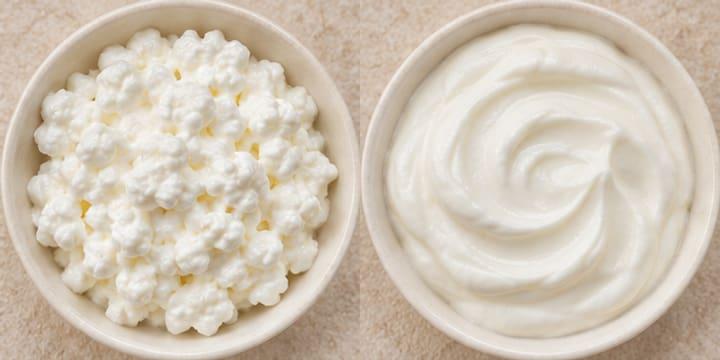
Use the weight printed on a single-serving pot or weigh the curds you spoon out. Cottage cheese works as a chunky toast topping, while strained yogurt makes a smooth base for berries. A full-fat Greek-style yogurt can differ substantially from the nonfat example.
Nutrition values and photo results are estimates. Check ingredients and portions before saving a meal.
Keep exploring
- Cottage cheese nutrition: calories, protein and portion sizesCottage cheese (2 g fat/100 g): about 92 kcal and 15.8 g protein per 100 g. See portion calculations, preparation notes and the exact Fineli source.
- Greek yogurt proteinPlain Greek yogurt has about 9–10 g of protein per 100 g, 15–17 g in a 170 g container and 22–25 g in a US cup. Compare servings, fat levels and skyr.
- Cottage cheese vs ricottaA lasagna filling can use either cheese, but the curd size, moisture and protein differ. Compare cottage cheese and whole-milk ricotta by weight.
- Quark vs cottage cheesePlain low-fat quark is smooth, while cottage cheese has visible curds. Compare the protein and calories for a bowl of either.
- Quark vs Greek yogurtCompare plain low-fat quark with plain nonfat Greek yogurt for breakfast. Both are thick, but their labels and amounts of protein vary between products.
- Food comparisonsCompare two foods at the same weight, then enter the portions you actually eat. Each guide names the preparation and links to the nutrient records behind the figures.
Sources and method
- THL Fineli · Cottage cheese, 2–5% fat (649)
- USDA FoodData Central · Plain nonfat Greek yogurt (170894)
- THL Fineli · CC BY 4.0
Finnish Institute for Health and Welfare (THL), Fineli, release 20.0. Selected reference values are scaled to edible portions and rounded.