Published by Saura ·
Quark vs Greek yogurt
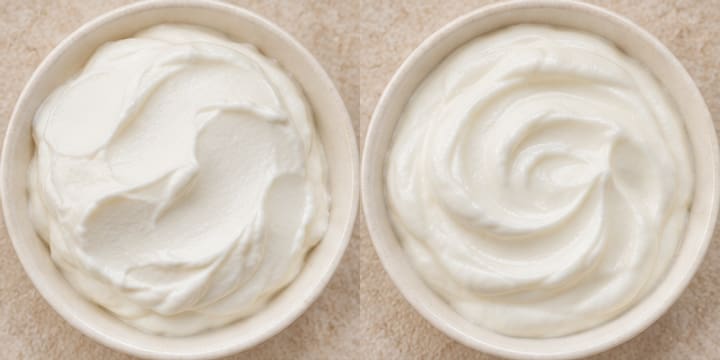
Compare plain low-fat quark with plain nonfat Greek yogurt for breakfast. Both are thick, but their labels and amounts of protein vary between products.
Quick answer
Protein per 100 g. Plain quark, under 0.5% fat — 9.8 g. Plain nonfat Greek yogurt — 10.2 g.
Compare your portions
Enter the weight of each food in the preparation shown.
Compare the two bars within each row. Each nutrient has its own scale.
| Nutrient | Plain quark, under 0.5% fat170 g | Plain nonfat Greek yogurt170 g |
|---|---|---|
| Energy | 101 kcal | 100 kcal |
| Protein | 16.7 g | 17.3 g |
| Available carbohydrate | 5.1 g | 6.1 g |
| Fat | 0.7 g | 0.7 g |
| Fiber | 0 g | 0 g |
Nutrition per 100 g
Values refer to 100 g of edible food in the stated preparation. Starting portions are examples. For USDA records, available carbohydrate is total carbohydrate minus fiber. Numbers are rounded after scaling.
Scroll sideways to see all columns. With a keyboard, focus the table and use the arrow keys.
| Nutrient | Plain quark, under 0.5% fat | Plain nonfat Greek yogurt |
|---|---|---|
| Energy | 59 kcal | 59 kcal |
| Protein | 9.8 g | 10.2 g |
| Available carbohydrate | 3 g | 3.6 g |
| Fat | 0.4 g | 0.4 g |
| Fiber | 0 g | 0 g |
How to use the comparison
For a more tart, spoonable bowl, use the amount of yogurt that fits your bowl. For a thicker filling, weigh the quark you spread. A Greek-style yogurt with 10% fat is a different reference from the nonfat yogurt here.
Nutrition values and photo results are estimates. Check ingredients and portions before saving a meal.
Keep exploring
- Quark nutrition: calories, protein and portion sizesQuark (under 0.5% fat): about 59 kcal and 9.8 g protein per 100 g. See portion calculations, preparation notes and the exact Fineli source.
- Greek yogurt proteinPlain Greek yogurt has about 9–10 g of protein per 100 g, 15–17 g in a 170 g container and 22–25 g in a US cup. Compare servings, fat levels and skyr.
- Cottage cheese vs Greek yogurtWhich has more protein in a breakfast bowl? Compare one specific cottage cheese with plain nonfat Greek yogurt, gram for gram and by tub size.
- Quark vs cottage cheesePlain low-fat quark is smooth, while cottage cheese has visible curds. Compare the protein and calories for a bowl of either.
- Food comparisonsCompare two foods at the same weight, then enter the portions you actually eat. Each guide names the preparation and links to the nutrient records behind the figures.
Sources and method
- THL Fineli · Plain quark, under 0.5% fat (622)
- USDA FoodData Central · Plain nonfat Greek yogurt (170894)
- THL Fineli · CC BY 4.0
Finnish Institute for Health and Welfare (THL), Fineli, release 20.0. Selected reference values are scaled to edible portions and rounded.